India..

Random Pick

RSS Feed

 Subscribe Our RSS Feed

Random Link

Iron Pillar OF Delhi
The Iron Pillar of Delhi

Archeological Findings


Iron Pillar OF Delhi
Mother Goddess(Harrappa)
Gautam Buddha
Gautam Buddha
Iron Pillar OF Delhi
The Golden Temple Sikhs
Iron Pillar OF Delhi
Jama Masjid-Islam

States Of India(28)

  1. Andhra Pradesh
  2. Arunachal Pradesh
  3. Assam
  4. Bihar
  5. Chhattisgarh
  6. Goa
  7. Gujarat
  8. Haryana
  9. Himachal Pradesh
  10. Jammu and Kashmir
  11. Jharkhand
  12. Karnataka
  13. Kerala
  14. Madhya Pradesh
  15. Maharashtra
  16. Manipur
  17. Meghalaya
  18. Mizoram
  19. Nagaland
  20. Orissa
  21. Punjab
  22. Rajasthan
  23. Sikkim
  24. Tamil Nadu
  25. Tripura
  26. Uttar Pradesh
  27. Uttarakhand
  28. West Bengal

Union Territories(7)

  1. Andaman & Nicobar
  2. Chandigarh
  3. Dadra&Nagar Haveli
  4. Daman and Diu
  5. Lakshadweep
  6. NCT of Delhi
  7. Puducherry

Indus Valley Civilization

Indian River Basins

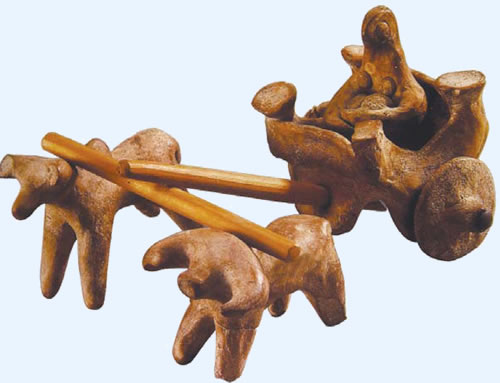
A terra Cotta Cart Of Harrappa ..

"The (Harappan) animal seals are among the world's greatest examples of an artist's ability to embody the essentials of a given form in artistic shape." (B. Rowland)

The Indus valley civilisation is also called the Harappan culture. Archaeologists use the term “culture” for a group of objects, distinctive in style, that are usually found together within a specific geographical area and period of time. In the case of the Harappan culture, these distinctive objects include seals, beads, weights, stone blades and even baked bricks. These objects were found from areas as far apart as Afghanistan, Jammu, Baluchistan (Pakistan) and Gujarat . Named after Harappa, the first site where this unique culture was discovered, the civilisation is dated between c. 2600 and 1900 BCE. There were earlier and later cultures, often called Early Harappan and Late Harappan, in the same area. The Harappan civilisation is sometimes called the Mature Harappan culture to distinguish it from these cultures.

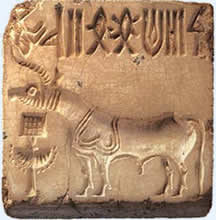
Harappan Seal


The Harappan seal in the above picture is possibly the most distinctive artefact of the Harappan or Indus valley civilisation. Made of a stone called steatite, seals like this one often contain animal motifs and signs from a script that still remains undeciphered.The above seal shows unicorn figure of Indus Valley culture. Whether it designates a real or mythical animal is unknown. Yet a great deal about the lives of the people who lived in the region, is known from what they left behind –their houses, pots, ornaments, tools and seals – in other words, from archaeological evidence.

Harppan Seal 

Major Developments in Harappan Archaeology

Nineteenth century

    1875                
  • Report of Alexander Cunningham on Harappan seal

Twentieth century

  • 1921                 M.S. Vats begins excavations at Harappa
  • 1925                 Excavations begin at Mohenjodaro
  • 1946                 R.E.M. Wheeler excavates at Harappa
  • 1955                 S.R. Rao begins excavations at Lothal
  • 1960                 B.B. Lal and B.K. Thapar begin excavations at Kalibangan
  • 1974                 M.R. Mughal begins explorations in Bahawalpur
  • 1980                 A team of German and Italian archaeologists begins surface explorations at Mohenjodaro
  • 1986                 American team begins excavations at Harappa
  • 1990                 R.S. Bisht begins excavations at Dholavira


The Plight Of Harrappa

Although Harappa was the first site to be discovered, it was badly destroyed by brick robbers. As early as 1875, Alexander Cunningham, the first Director-General of the Archaeological Survey of India (ASI), often called the father of Indian archaeology, noted that the amount of brick taken from the ancient site was enough to lay bricks for “about 100 miles” of the railway line between L ahore and Multan. Thus, many of the ancient structures at the site were damaged. In contrast, Mohenjodaro was far better preserved.

The Seals,Script,Weights...

Indus Script
The Yet to be deciphered Indus Script

The Delphian- Enigmatic Script

Harappan seals usually have a line of writing, probably containing the name and title of the owner. Scholars have also suggested that the motif (generally an animal) conveyed a meaning to those who could not read. Most inscriptions are short, the longest containing about 26 signs. Although the script remains undeciphered to date, it was evidently not alphabetical (where each sign stands for a vowel or a consonant) as it has just too many signs – somewhere between 375 and 400. It is apparent that the script was written from right to left as some seals show a wider spacing on the right and cramping on the left, as if the engraver began working from the right and then ran out of space. Consider the variety of objects on which writing has been found: seals, copper tools, rims of jars, copper and terracotta tablets, jewellery, bone rods, even an ancient signboard! Remember, there may have been writing on perishable materials too. May be this could mean that literacy was wide spread.

Weights:

Exchanges were regulated by a precise system of weights, usually made of a stone called chert and generally cubical , with no markings. The lower denominations of weights were binary (1, 2, 4, 8, 16, 32, etc. up to 12,800), while the higher denominations followed the decimal system. The smaller weights were probably used for weighing jewellery and beads. Metal scale-pans have also been found. 

Agriculture Practice

While the prevalence of agriculture is indicated by finds of grain, it is more difficult to reconstruct actual agricultural practices. Were seeds broadcast (scattered) on ploughed lands? Representations on seals and terracotta sculpture indicate that the bull was known, and archaeologists extrapolate from this that oxen were used for ploughing. Moreover, terracotta models of the plough have been found at sites in Cholistan and at Banawali (Haryana). Archaeologists have also found evidence of a ploughed field at Kalibangan (Rajasthan), associated with Early Harappan levels (see p. 20). The field had two sets of furrows at right angles to each other, suggesting that two different crops were grown together. Archaeologists have also tried to identify the tools used for harvesting. Did the Harappans use stone blades set in wooden handles or did they use metal tools? Most Harappan sites are located in semi-arid lands, where irrigation was probably required for agriculture. Traces of canals have been found at the Harappan site of Shortughai in Afghanistan, but not in Punjab or Sind. It is possible that ancient canals silted up long ago. It is also likely that water drawn from wells was used for irrigation. Besides, water reservoirs found in Dholavira (Gujarat) may have been used to store water for agriculture.

The RULERS
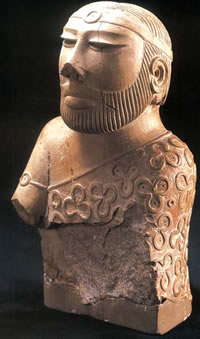
Priest King
The Preist King
If we look for a centre of power or for depictions of people in power, archaeological records provide no immediate answers. A large building found at Mohenjodaro was labelled as a palace by archaeologists but no spectacular finds were associated with it. A stone statue was labelled and continues to be known as the “priest-king”. This is because archaeologists were familiar with Mesopotamian history and its “priest-kings” and have found parallels in the Indus region. But as we will see (p.23), the ritual practices of the Harappan civilisation are not well understood yet nor are there any means of knowing whether those who performed them also held political power. Some archaeologists are of the opinion that Harappan society had no rulers, and that everybody enjoyed equal status. Others feel there was no single ruler but several, that Mohenjodaro had a separate ruler, Harappa another, and so forth. Yet others argue that there was a single state, given the similarity in artefacts, the evidence for planned settlements, the standardised ratio of brick size, and the establishment of settlements near sources of raw material. As of now, the last theory seems the most plausible, as it is unlikely that entire communities could have collectively made and implemented such complex decisions.

Mohenjodaro

A Well Planned Urban Centre

Everyone is quiet aware of the chaotic life of Urban cities today. The unplanned roads, unplanned buildings... make urban living a bit hard. But some 4000 years before Indus valley civilization had well planned roads, well planned houses with attached bath, attached well. The well planned city of Mohenjodaro has no parllel either at that times or may be now alsoSmiley

Although Mohenjodaro is the most well-known site, the first site to be discovered was Harappa.The settlement is divided into two sections, one smaller but higher and the other much larger but lower. Archaeologists designate these as the Citadel and the Lower Town respectively. The Citadel owes its height to the fact that buildings were constructed on mud brick platforms. It was walled, which meant that it was physically separated from the Lower Town.

 The Lower Town was also walled. Several buildings were built on platforms, which served as foundations. It has been calculated that if one labourer moved roughly a cubic metre of earth daily, just to put the foundations in place it would have required four million person-days, in other words, mobilising labour on a very large scale.

 Consider something else. Once the platforms were in place, all building activity within the city was restricted to a fixed area on the platforms. So it seems that the settlement was first planned and then implemented accordingly. Other signs of planning include bricks, which, whether sun-dried or baked, were of a standardised ratio, where the length and breadth were four times and twice the height respectively. Such bricks were used at all Harappan settlements.

 One of the most distinctive features of Harappan cities was the carefully planned drainage system. If you look at the plan of the Lower Town you will notice that roads and streets were laid out along an approximate “grid” pattern, intersecting at right angles. It seems that streets with drains were laid out first and then houses built along them. If domestic waste water had to flow into the street drains, every house needed to have at least one wall along a street.


About the drains, Mackay noted: “It is certainly the most complete ancient system as yet discovered.” Every house was connected to the street drains. The main channels were made of bricks set in mortar and were covered with loose bricks that could be removed for cleaning. In some cases, limestone was used for the covers. House drains first emptied into a sump or cesspit into which solid matter settled while waste water flowed out into the street drains. Very long drainage channels were provided at intervals with sumps for cleaning. It is a wonder of archaeology that “little heaps of material, mostly sand, have frequently been found lying alongside drainage channels, which shows … that the debris was not always carted away when the drain was cleared”.- Megasthenes in His Indika

The Puzzles

 The frontiers of the Harappan civilisation have little or no connection with present-day national boundaries. However, with the partition of the subcontinent and the creation of Pakistan, the major sites are now in Pakistani territory. This has spurred Indian archaeologists to try and locate sites in India. An extensive survey in Kutch has revealed a number of Harappan settlements and explorations in Punjab and Haryana have added to the list of Harappan sites. While Kalibangan, Lothal, Rakhi Garhi and most recently Dholavira have been discovered, explored and excavated as part of these efforts, fresh explorations continue.

 Over the decades, new issues have assumed importance. Where some archaeologists are often keen to obtain a cultural sequence, others try to understand the logic underlying the location of specific sites. They also grapple with the wealth of artefacts, trying to figure out the functions these may have served.

 Since the 1980s, there has also been growing international interest in Harappan archaeology. Specialists from the subcontinent and abroad have been jointly working at both Harappa and Mohenjodaro. They are using modern scientific techniques including surface exploration to recover traces of clay, stone, metal and plant and animal remains as well as to minutely analyse every scrap of available evidence. These explorations promise to yield interesting results in the future.Smiley

ArteCrafts

Great Bath Mohenjo-Daro
The Harrappan Pottery
Chanhudaro is a tiny settlement (less than 7 hectares) as compared to Mohenjodaro (125 hectares), almost exclusively devoted to craft production, including bead-making, shell-cutting, metal-working, seal-making and weight-making.The variety of materials used to make beads is remarkable: stones like carnelian (of a beautiful red colour), jasper, crystal, quartz and steatite; metals like copper, bronze and gold; and shell, faience and terracotta or burnt clay. Some beads were made of two or more stones, cemented together, some of stone with gold caps. The shapes were numerous – discshaped, cylindrical, spherical, barrel-shaped, segmented. Some were decorated by incising or painting, and some had designs etched onto them.

 Techniques for making beads differed according to the material. Steatite, a very soft stone, was easily worked. Some beads were moulded out of a paste made with steatite powder. This permitted making a variety of shapes, unlike the geometrical forms made out of harder stones. How the steatite micro bead was made remains a puzzle for archaeologists studying ancient technology..Specialised drills have been found at Chanhudaro, Lothal and more recently at Dholavira.

Contact With Distant Lands

Mesopotamian texts datable to the third millennium BCE refer to copper coming from a region called Magan, perhaps a name for Oman, and interestingly enough copper found at Mesopotamian sites also contains traces of nickel. Other archaeological finds suggestive of longdistance contacts include Harappan seals, weights, dice and beads. In this context, it is worth noting that Mesopotamian texts mention contact with regions named Dilmun (probably the island of Bahrain), Magan and Meluhha, possibly the Harappan region. They mention the products from Meluhha: carnelian, lapis lazuli, copper, gold, and varieties of wood. A Mesopotamian myth says of Meluhha: “May your bird be the haja-bird, may its call be heard in the royal palace.” Some archaeologists think the haja-bird was the peacock. Did it get this name from its call? It is likely that communication with Oman, Bahrain or Mesopotamia was by sea. Mesopotamian texts refer to Meluhha as a land of seafarers. Besides, we find depictions of ships and boats on seals.

The Mysterious End ....

 There is evidence that by c. 1800 BCE most of the Mature Harappan sites in regions such as Cholistan had been abandoned. Simultaneously, there was an expansion of population into new settlements in Gujarat, Haryana and western Uttar Pradesh. In the few Harappan sites that continued to be occupied after 1900 BCE there appears to have been a transformation of material culture, marked by the disappearance of the distinctive artefacts of the civilisation – weights, seals, special beads. Writing, long-distance trade, and craft specialisation also disappeared. In general, far fewer materials were used to make far fewer things. House construction techniques deteriorated and large public structures were no longer produced. Overall, artefacts and settlements indicate a rural way of life in what are called “Late Harappan” or “successor cultures”.

What brought about these changes? Several explanations have been put forward. These range from climatic change, deforestation, excessive floods, the shifting and/or drying up of rivers, to overuse of the landscape. Some of these “causes” may hold for certain settlements, but they do not explain the collapse of the entire civilisation.

It appears that a strong unifying element, perhaps the Harappan state, came to an end. This is evidenced by the disappearance of seals, the script, distinctive beads and pottery, the shift from a standardised weight system to the use of local weights; and the decline and abandonment of cities. The subcontinent would have to wait for over a millennium for new cities to develop in a completely different region.

Invasion By Indra ?---

Based on sekeltons of armed people at the dead vally of Mohenjodaro, Mr. Wheeler drawn a conclusion of some massarce of Mohenjadero..

" Indra, the Aryan war-god is called puramdara, the fort-destroyer. Where are – or were – these citadels? It has in the past been supposed that they were mythical … The recent excavation of Harappa may be thought to have changed the picture. Here we have a highly evolved civilisation of essentially non- Aryan type, now known to have employed massive fortifications … What destroyed this firmly settled civilisation? Climatic, economic or political deterioration may have weakened it, but its ultimate extinction is more likely to have been completed by deliberate and large-scale destruction. It may be no mere chance that at a late period of Mohenjodaro men, women, and children, appear to have been massacred there. On circumstantial evidence, Indra stands accused. "

--From R.E.M. WHEELER, “Harappa 1946”,

In the 1960s, the evidence of a massacre in Mohenjodaro was questioned by an archaeologist named George Dales. He demonstrated that the skeletons found at the site did not belong to the same period: Whereas a couple of them definitely seem to indicate a slaughter, … the bulk of the bones were found in contexts suggesting burials of the sloppiest and most irreverent nature. There is no destruction level covering the latest period of the city, no sign of extensive burning, no bodies of warriors clad in armour and surrounded by the weapons of war. The citadel, the only fortified part of the city, yielded no evidence of a final defence.

---FROM G.F. DALES, “The Mythical Massacre at Mohenjodaro”, Expediton, 1964.

Indus Valley-Updates

Sunday, 9 Aug 2009

Indus Script May Reveal It's Secrets!!!

Indus Script is a writing system.. says recent paper... 


Read more...

Date: 9 Aug 2009 , Author: dilip / Category: Indus / Views: 237/Rating:0