
MADMAHESWAR
The Five Kedars
-
Please click on the name to know details.
- Tunganath: 3,810 m
- Kedarnath: 3584 m
- Madmaheswar: 3289 m
- Rudranath: 2286 m.
- Kalpeshwar: 2134 m.
This is the note of a traveller and is being provided as it is..
You can check complete details of the author's experience here,from which this information has been taken.
Quick Facts
How to Reach: 42 kms from Guptkashi via Uniana(22 kms motorable) – Ransi- Gaundhan(20 km trek) . Guptkashi is 10 kms from Ukhimath.
Altitude: 3490 mts
When to Go: September – Mid November
Guptakashi
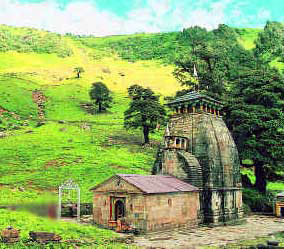
- Madmaheswar Temple
Those who are keen on a longer trek like us can get off the bus or car at a place called Devidhar from where there is a delightful forest track up to Kalimath, which is our first halting place. The three kilometer walk took us through a thickly wooded slope carpeted with the leaves of pines and deodars, which are centuries old and which muffle our footsteps. This track leads to the stream called Kali. From here the track winds up to the tiny village in which is situated the temple of Kali Mata or the Goddess Kali. The temple is open on all sides and is surrounded by striking red wooden pillars. It is a siddha peeth in which one of the parts of the Goddess Sati is supposed to have fallen. Siddha peeths are said to have the ability to fulfill all our wishes.
After an overnight stay at Kali Math the trek continued along an undulated terrain with thickly terraced slopes. The river known as the Madmaheswar Ganga could be seen far below, glinting and sparkling in the sunlight. Seven kilometers from Kali Math we reached the little hamlet known as Raun Lek where we stayed at a humble homestead. We had decided not to be hustled on our journey but to go slowly and thus enjoy the scenic beauty and the feel of the land by staying with the peasants. The little room that they gave us was not as clean as one would have liked but the cobbled terrace where they gave us dinner had a breathtaking view of the entire valley with the roar of the river thrown in for extra measure. In the distance was the magnificent Chaukamba peak on which the setting sun was giving special light effects. No five star hotel could ever boast of such idyllic surroundings. The long Himalayan twilight drifted into an enchanted night with a sky, studded with huge stars hanging low over our heads! This was not a five-star hotel but a million-star one! Very soon the eighth-day moon came out to enhance the beauty of the scene. We sat on the terrace and soaked in the atmosphere while our host regaled us with surprising bits of information coming from one living in such a remote spot. He also told us of an alternate route from Gaundhar which could be reached by taxi from Guptakashi. Of course this route would totally cut out the beautiful temple of Kali Mata.
It is always good to set out as early as possible when you are trekking in the hills. In summer the day gets light by 4.30am and we covered the 8 kilometers to Ransi in a fairly short time since the terrain was not hilly. Here there was an ancient temple to the Goddess Rakheswari and we rested a while in the dim recesses of this temple, enfolded in the benign waves emanating from the goddess. Our night halt was at Gaundhar so we set out as fast as possible. The walk to Gaundhar was really charming. The track winds up for a while and then started going down through pine forests. Many a turn in the path brought us face to face with fantastic waterfalls and secret pools. Wild strawberries nestled in clusters of dark green leaves. We didn’t have time to gather them but just then a “pahari” (hill) belle approached us and thrust some of the delicious berries into our hands. What could we offer in exchange for this manna from the gods? Sacrilegious to think of giving biscuits and artificially flavoured sweets.
Ransi and Gaundhar
The priest at Ransi had warned us not to stay at Gaundhar, which is where all pilgrims halt, but to push on another 1 kilometer to Vantoli, which is actually the base camp for the ascent to Madmaheswar. This spot was one of the most charming we had ever stayed so far. There is a confluence of two rivers here and the tiny homestead where we halted nestles in the lap of a vale with towering peaks on one side and the roar of the waters as they rush to meet each other at the confluence. We had an exhilarating bath in the icy waters, clinging on to a branch of a tree for fear of being swept away by the current. After this we were ravenous. Never had we eaten such a delicious meal. Just plain chapattis with some green leaves that the little boy ran and plucked from the adjoining fields and some thick curds. The milk and curds in these hills are really wonderful – thick and creamy from cows fed on green grass and leaves alone. Potatoes were a luxury since that year’s crop had not been harvested and most of them were too poor to go to the nearest town to buy such “luxuries”! Magic moments when we wandered along the river and sat on sun-bleached rocks, sprinkled with the icy spray from the foaming, swirling, dancing waters around. I wonder if any sophisticated mountain resort could compare with this pristine beauty!The next day was the last and most difficult part of our journey. We had to do nine kilometers of really stiff climbing with only one hamlet in between where we might get some refreshments. The track wound its way through shady pine-clad slopes to the hamlet. After a short break we commenced the hard climb, sometimes through forests and sometimes over bare slopes. The river was only a silver streak far down below from which the wind wafted the faint sounds of the roaring waters which had turned into a whisper. Even though it was a hard climb, the sight of the pink and red rhododendron flowers encouraged us to push on. Creepers trailed their vines across our tired faces as if to comfort us. We had been warned to be on the look out for bears but nary a one did we ever see! However we did see a couple of playful creatures resembling back and white badgers who were not in the least bit put out by this invasion of their privacy.
Due to its inaccessibility Madmaheswar is off the beaten track for most rich pilgrims and the poor ones cannot afford ponies and baskets! We felt as if the whole world belonged to us alone. The only sound to assail our ears was the mournful screech of the Himalayan eagle and the muted murmur of the waters below.